


Full Size vs Mini Light Bar: Which Is Right for Your Emergency Vehicle?
Most people searching this question already know they need a light bar. They've done the "do I need one" research. Now they're standing at the actual decision: go full size or keep it compact?
It's a genuine fork in the road — and picking the wrong one costs you money, visibility, or both.
The honest answer isn't "bigger is always better" or "mini bars are just as good." The right answer depends on your vehicle type, your operational role, your state's mounting requirements, and what you actually need the light bar to do. Get those factors right and the choice becomes obvious.
Here's how to think through it.
What Separates a Full-Size Bar from a Mini Bar

At the most basic level, the difference is size — but size drives everything else: output, coverage, mounting complexity, and cost.
A full-size light bar runs 36 to 55 inches across the roof of a vehicle. It spans most or all of the roofline, mounts via permanent brackets, and integrates multiple lighting zones into one unit — forward takedowns, side alley lights, rear-facing warning modules, and 360-degree perimeter visibility all built into a single bar.
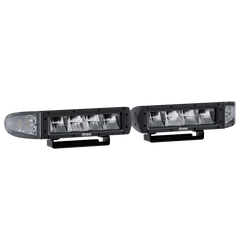
A mini light bar runs 10 to 24 inches. It mounts in the center of the roof or on a dash bracket, delivers forward and side warning from a single compact unit, and installs in a fraction of the time. It doesn't have takedowns or alley lights in most configurations, but it gives you genuine SAE Class 1 output in a footprint that fits almost any vehicle.
Both can be SAE Class 1 certified. Both can deliver professional-grade visibility. The question is whether you need everything a full-size bar provides — or whether a mini does the actual job your vehicle requires.
The types of emergency vehicle warning lights guide at Abrams MFG covers every light bar category in detail if you want a broader comparison before narrowing down.
When Full-Size Is the Right Call

A full-size light bar earns its place on specific vehicle types. If your situation matches any of these, don't talk yourself into a smaller unit.
Primary law enforcement patrol vehicles. A patrol car needs to be seen from every direction simultaneously — oncoming traffic, side streets, following traffic, and pedestrians at an intersection. Full-size bars deliver that 360-degree coverage with built-in takedown lights that flood the area in front of the vehicle and alley lights that illuminate both sides during traffic stops. A mini bar simply can't replicate that full-perimeter warning.
Fire apparatus and first-response vehicles. Fire trucks and heavy rescue apparatus need maximum visibility at distance. When a 40,000-pound fire truck approaches an intersection at speed, the light bar needs to be visible from far enough away that cross-traffic has time to stop. Full-size output at Class 1 standards is the only appropriate choice here.
Highway patrol and state troopers. Highway use puts vehicles in fast-moving traffic where sightlines are long and vehicles approach at high speed. The additional output and length of a full-size bar provides significantly more warning distance than a compact unit.
Ambulances and EMS primary response. EMS vehicles need rear-facing visibility as much as forward — they're often stopped in traffic while treating patients in the roadway. Full-size bars with dedicated rear modules cover that exposure in a way mini bars can't match.
The Abrams MFG full-size light bar collection includes SAE Class 1 certified options in red/blue, red/blue/white, and amber configurations — sized from 36 inches to 55 inches for different vehicle platforms.
When a Mini Bar Is the Smarter Choice

Mini light bars get underestimated. Plenty of buyers assume "smaller" means "less professional" — but that's not how the specs work. A quality mini bar at Class 1 certification puts out serious warning capability. The question is whether its coverage profile matches what you need.
Detective and plainclothes enforcement vehicles. An unmarked sedan running a 47-inch full-size bar is no longer unmarked in any practical sense. A mini bar on a magnetic mount sits flat on the roof, doesn't announce itself visually when inactive, and provides the warning capability needed during enforcement operations without permanently altering the vehicle's appearance.
Secondary patrol units and supervisory vehicles. Not every department vehicle needs the full primary patrol setup. A supervisor's car, a community liaison vehicle, or a secondary response unit can operate effectively with a mini bar that costs less, installs faster, and still delivers compliant warning output.
Volunteer firefighter personal vehicles. In states that authorize warning lights on volunteer FF personal vehicles, a mini bar is the practical choice. It installs without permanent modification in many magnetic configurations, it's removable when the vehicle goes back to personal use, and it meets the warning requirements for authorized emergency response.
Municipal and utility vehicles. Parking enforcement, animal control, public works supervisors, and municipal inspection vehicles all need some level of warning visibility without the full law enforcement setup. Mini bars cover this category cleanly.
Budget-conscious smaller departments. When you're outfitting ten vehicles on a constrained budget, the cost difference between a full-size and mini bar multiplied across a fleet is significant. If the operational requirements genuinely support a mini configuration, the savings are real without compromising safety.
Browse the complete mini light bar collection at Abrams MFG — available in single-color, dual-color, and multicolor configurations with both magnetic and permanent mount options.
Side-by-Side Comparison
|
Feature |
Full-Size Bar |
Mini Light Bar |
|
Length |
36–55 inches |
10–24 inches |
|
360° coverage |
Yes — built-in |
Partial — forward/side focus |
|
Takedown lights |
Yes — most models |
No |
|
Alley lights |
Yes — most models |
No |
|
SAE Class 1 capable |
Yes |
Yes |
|
Magnetic mount option |
Limited |
Yes — most models |
|
Install complexity |
High — permanent preferred |
Low to moderate |
|
Ideal vehicle |
Primary patrol, fire, EMS |
Secondary units, unmarked, volunteer |
|
Flash patterns |
30–65+ |
15–30+ |
|
Visibility distance |
500–1,000+ feet |
300–600 feet |
|
Cost |
Higher |
Lower |
Key Specs to Check on Either Type
Whether you're buying full-size or mini, the same core specifications determine whether the product is worth your money.
SAE Class rating. The Society of Automotive Engineers sets Class 1, 2, and 3 performance thresholds. For any vehicle operating in traffic in an authorized warning capacity, Class 1 is the minimum. Don't buy a light bar that doesn't clearly state its SAE class — and don't trust one that claims Class 1 without documentation.
IP rating. Any light mounted on the exterior of a vehicle needs IP67 minimum — fully dust-tight and submersible to 1 meter for 30 minutes. The IEC's IP rating standard defines exactly what each designation means. IP67 handles rain, road spray, and pressure washing. Anything below that is a liability on an outdoor-mounted light.
Flash pattern count. More patterns give you operational flexibility. Traffic stop, pursuit, intersection clearance, and scene management each benefit from different flash cadences. Look for at least 15–20 patterns on a mini bar and 30+ on a full-size.
Sync capability. If you're running other Abrams warning products — LED grill lights, hideaway strobe lights, or beacon lights — confirm the light bar syncs with them. Coordinated flash across all vehicle lights looks professional and creates a stronger warning signal than independent units running out of phase.
Voltage range. Standard vehicle electrical systems run 12V DC. Heavy equipment and some commercial vehicles run 24V. Most Abrams MFG bars support 10–30V DC input, which covers both.
Color Options and Legal Requirements
Both full-size and mini bars come in the same color options — what matters is whether your vehicle type and state authorize the color you want to run.
-
Red/Blue — law enforcement, authorized emergency vehicles
-
Red/Blue/White — primary patrol with takedown and alley capability
-
Amber — tow trucks, construction, utility, DOT vehicles — legal in all 50 states for authorized work vehicles
-
Amber/White — highway maintenance and snow plow operations
-
Red/Amber — select states for specific tow and fire applications
-
Green — emergency management and volunteer EMS in authorized states
-
Purple — funeral processions in states that authorize it
Before you finalize a color configuration, verify your state's authorization. The emergency vehicle lighting laws by state guide and the state-by-state color legality breakdown cover the full picture. The Federal Highway Administration's state DOT directory links directly to each state's motor vehicle authority if you need to verify local requirements directly.
Mounting: What Each Type Requires
Full-size bars almost always require permanent mounting — brackets that attach to the roof rails or door frames, with hardwired power connection to the vehicle's electrical system. This is the right setup for any vehicle that always operates as an emergency or warning vehicle. Plan for 2–4 hours of install time per vehicle.
Mini bars give you options. Most models are available in both magnetic and permanent configurations. Magnetic mount is quick, transferable between vehicles, and requires no drilling. Permanent mount is more secure, looks cleaner, and is appropriate for dedicated fleet vehicles.
For guidance on when magnetic vs permanent mount makes sense, the LED beacon light buying guide covers the mounting decision in depth — same principles apply to mini bars.
If you're outfitting an entire fleet and need installation support or compliance documentation, the Abrams MFG fleet solutions page handles bulk orders and department purchasing with full spec support.
Frequently Asked Questions
Can a mini light bar replace a full-size bar on a primary patrol car? In most cases, no. Primary patrol vehicles need 360-degree coverage, takedown lights, and alley lights — features built into full-size bars that mini bars don't include. Mini bars work well for secondary units, unmarked vehicles, and auxiliary roles where full perimeter coverage isn't the requirement.
Is a mini bar loud enough — does it have a siren? Neither full-size nor mini bars include a siren on their own. The light bar provides visual warning only. For audio warning, you need a separate siren and speaker system that pairs with your lighting setup.
What's the right size full-size bar for a Ford Explorer or Tahoe? Most departments use a 47–52 inch bar on full-size SUV platforms. Measure your roofline before ordering — bar length should not exceed the roof width at the mounting point.
Can civilians buy and install mini light bars? Mini bars are legal to purchase in all states. Whether you can operate one on a public road depends entirely on your vehicle type, authorization status, and state law. The can civilians use emergency lights guide covers authorization by category in detail.
Do Abrams mini bars sync with full-size bars on the same vehicle? Yes. Abrams MFG products are built to sync across the product lineup — mini bars, full-size bars, grill lights, beacons, and hideaway strobes all coordinate when connected through the Abrams sync system.
Choose the Right Bar for Your Vehicle
The decision comes down to your vehicle's role, your operational requirements, and your authorization level.
If you run primary patrol, fire, or EMS response — go full-size. If you run secondary units, unmarked vehicles, volunteer response, or municipal work vehicles — a mini bar does the job at lower cost and easier install.
Both are available at Abrams MFG with SAE Class 1 certification, IP67 waterproofing, and manufacturer warranty.
