


How to Choose the Right Siren System for Emergency Vehicles
A lot of departments spend serious time choosing the right light bar and almost no time choosing the right siren. Then they wonder why drivers in the next block aren't reacting until the vehicle is right on top of them.
Visual warning and audible warning aren't interchangeable — they serve different distances and different driver behaviors. A driver checking their mirror registers flashing lights. A driver looking at their phone responds to sound. Choosing the right siren system for emergency vehicles means understanding which situations each siren type handles best, what wattage your vehicle actually needs, and how the full audio warning system fits together.
This guide covers every decision point: siren types, wattage, PA integration, speaker placement, and how to match the system to your specific vehicle and operational role.
Types of Siren Systems: Electronic vs Pneumatic

The first decision is the most fundamental. Every siren system falls into one of two categories — and each has a specific role.
Electronic Sirens
Electronic sirens use amplifiers and oscillators to generate warning tones electronically. They're compact, mount inside the cab, draw manageable current, and offer the widest range of siren tones and features available.
Standard electronic siren tones include:
Wail — the long, rising-and-falling tone used for general approach warning. Travels 350+ feet ahead of the vehicle at highway speeds. Best for open roads and highway approaches where you need maximum advance warning distance.
Yelp — a fast, repeating short burst. More urgent than wail, used at intersections and in traffic where immediate driver response is needed. Higher repetition rate creates more urgency than a sustained tone.
Piercer / Phaser — high-frequency rapid tone used during pursuits or high-urgency situations. Penetrates urban noise more effectively than lower-frequency tones.
Air Horn — electronic simulation of a truck air horn. Effective at close range for immediate attention — typically used at intersections when other traffic fails to yield.
Rumbler / Low-Frequency — a newer tone category that produces deep, bass-frequency pulses designed to be felt inside other vehicles as much as heard. Particularly effective in urban environments where high-frequency tones get absorbed by buildings, and in vehicles with heavy sound insulation.
Research cited by the U.S. Department of Transportation on emergency vehicle warning effectiveness confirms that low-frequency tones penetrate enclosed vehicle cabins significantly better than traditional high-frequency sirens — a growing concern as modern vehicles become increasingly soundproofed.
Pneumatic Sirens
Pneumatic sirens use pressurized air to produce sound mechanically. They're significantly louder at close range than most electronic sirens, extremely durable, and traditionally used on fire apparatus and heavy ambulances where maximum raw output matters more than tone variety.
The tradeoff: they're bulky, require an air compressor system, and offer limited tone options compared to electronic units. For most law enforcement, EMS, and secondary emergency vehicle applications, electronic is the practical choice. For heavy fire apparatus that needs maximum audibility in the immediate area, pneumatic still has a role.
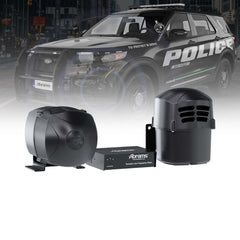
For most departments and fleet operators reading this guide, electronic is your answer. Abrams MFG's siren kits collection covers electronic systems for police, fire, EMS, and security vehicle applications.
Pneumatic Sirens
Pneumatic sirens use pressurized air to produce sound mechanically. They're significantly louder at close range than most electronic sirens, extremely durable, and traditionally used on fire apparatus and heavy ambulances where maximum raw output matters more than tone variety.
The tradeoff: they're bulky, require an air compressor system, and offer limited tone options compared to electronic units. For most law enforcement, EMS, and secondary emergency vehicle applications, electronic is the practical choice. For heavy fire apparatus that needs maximum audibility in the immediate area, pneumatic still has a role.
For most departments and fleet operators reading this guide, electronic is your answer. Abrams MFG's siren kits collection covers electronic systems for police, fire, EMS, and security vehicle applications.
Siren Wattage: 100W vs 200W — Which Do You Need?

Wattage determines output volume. More watts means more decibels. But the right wattage depends on your vehicle type and operational environment — not a simple "bigger is better" calculation.
|
100W System |
200W System |
|
|
Typical dB output |
110–117 dB |
119–124 dB |
|
Best for |
Patrol cars, secondary units, motorcycles |
Primary response, fire apparatus, highway units |
|
Speaker compatibility |
Standard 100W speakers |
Requires 200W rated speakers |
|
Power draw |
Lower — suits most vehicles |
Higher — confirm vehicle alternator capacity |
|
Cost |
Lower |
Higher |
|
Urban noise penetration |
Good |
Excellent |
100W systems handle the majority of law enforcement patrol applications effectively. A 100W electronic siren on a police cruiser running standard tones produces sufficient warning for most suburban and urban environments where speed limits and traffic conditions keep approach speeds manageable.
200W systems earn their place on primary response units, highway patrol vehicles, and heavy apparatus. The additional output translates to approximately 3–6 more decibels — which sounds modest but is a meaningful difference in penetrating wind noise, highway traffic noise, and the interior of modern sound-insulated vehicles at speed.
The SAE J1849 standard governs siren performance requirements for emergency vehicles — specifying frequency range (500 Hz–2,000 Hz for standard tones), minimum decibel output at specified distances, and tone quality. Verify any siren you purchase is SAE J1849 compliant before ordering for official fleet use.
According to Government Fleet Magazine's 2024 Police Fleet Conference reporting, police cars are increasingly specified with 200W systems as urban noise floors rise and vehicle sound insulation improves — pushing more departments to specify higher-output systems even for standard patrol applications.
PA Systems, Radio Repeat and Speaker Placement

The siren controller is only part of the audio warning system. Three additional features significantly affect real-world performance.
PA System Integration
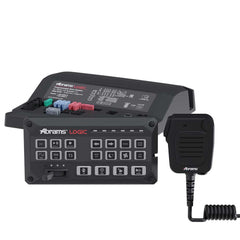
A PA (Public Address) system connects a handheld or mounted microphone to your siren's amplifier and speaker, letting the operator broadcast voice instructions through the vehicle's external speaker. PA is standard on virtually all electronic siren systems and used constantly in law enforcement and EMS for scene management, suspect commands, and crowd direction.
When evaluating PA capability, check: maximum PA wattage through the external speaker, whether the PA overrides the siren tone or operates simultaneously, and whether a hands-free option is available. Hands-free PA reduces distracted driving — an increasingly specified feature per the IACP (International Association of Chiefs of Police) fleet equipment guidelines.
Radio Repeat
Radio repeat routes your vehicle's radio audio through the external siren speaker — allowing the operator to broadcast radio transmissions to personnel outside the vehicle at a scene. Useful for incident command operations and any situation where crew outside the vehicle need to monitor radio traffic. Most current electronic siren systems include this feature.
Speaker Placement
The speaker does as much work as the amplifier. A 200W amplifier driving a poorly positioned speaker underperforms a 100W amplifier with optimal placement.
Front-mounted speakers (grille or bumper position) project sound forward — where it matters most for intersection clearance and oncoming traffic warning. This is the standard position for a single-speaker setup on patrol vehicles.
Dual-speaker setups add a second speaker for rear or side coverage — useful on vehicles that frequently work in positions where rear warning matters, or on heavy apparatus that needs omnidirectional audible warning.
Match speaker wattage rating to your amplifier output. An underpowered speaker on a 200W system distorts and clips under load — degrading both tone quality and output volume.
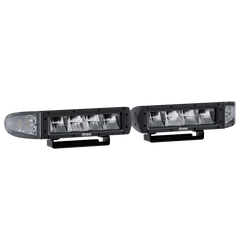
Pair your siren and speaker system with your vehicle's lighting setup for full coordinated warning. The full-size light bar collection at Abrams MFG includes models that integrate with siren controller outputs for zone-lighting control through a single cab interface.
Matching the Siren System to Your Vehicle Type
Not every vehicle needs the same configuration. Here's how to think through the match.
Police patrol vehicles: 100W or 200W electronic siren with full tone library, PA, radio repeat, and hands-free operation. Front grille-mounted speaker. Integration with lighting controller preferred.
Ambulances and EMS vehicles: 200W system with PA, radio repeat, and consideration for a rumbler/low-frequency unit to supplement the primary siren. EMS vehicles frequently operate in urban environments where low-frequency penetration matters most.
Fire apparatus: 200W electronic or pneumatic system. Heavy apparatus needs maximum raw output — dual-speaker setups are standard on engine and ladder companies. Air horn function (electronic or pneumatic) is essential.
Volunteer firefighter personal vehicles: In states that authorize audible warning for responding volunteers, a compact 100W electronic siren with front-mount speaker covers the authorized warning capability. Always verify your state's siren authorization for volunteer responders — our can civilians use emergency lights guide covers authorization by vehicle category including siren use.
Security vehicles: Most states do not authorize siren use on private security vehicles. Confirm your state's rules before purchasing.
For department-level purchasing across multiple vehicle types, the Abrams MFG fleet solutions page handles bulk siren and speaker system orders with compliance documentation support.
SAE Standards, Legal Requirements & Installation Basics
Legal authorization: Only authorized emergency vehicles can legally operate sirens on public roads in most states. Sirens on unauthorized vehicles constitute impersonating an emergency vehicle. Check your state's vehicle code — the NHTSA and individual state DOT directories confirm jurisdiction-specific requirements.
SAE J1849 compliance: Ensures your siren meets minimum tone frequency, output, and quality standards. Required for official fleet procurement in most states. All compliant siren systems should display their SAE rating — if a product doesn't list it, that's a flag.
Installation basics:
-
Mount the amplifier inside the cab, away from heat sources and moisture penetration paths
-
Run speaker wire in 16-gauge minimum — 14-gauge for 200W systems
-
Fuse the power feed within 18 inches of the battery connection
-
Ground to bare metal — paint-to-frame grounds cause intermittent audio distortion
-
Route the microphone cable away from radio antenna leads to prevent interference
For detailed wiring guidance that applies to siren system installation, the how to wire emergency lights guide covers circuits, fusing, and grounding principles that apply to all 12V vehicle electrical installations.
Conclusion
Choosing the right siren system for emergency vehicles comes down to four decisions: electronic vs pneumatic, 100W vs 200W, speaker placement, and feature set (PA, radio repeat, hands-free). Get those four right for your vehicle type and your operational environment, and the system works every time it's needed.
Abrams MFG supplies complete siren systems — amplifiers, speakers, and controllers — for police, fire, EMS, and security fleet applications. Every unit is built to SAE standards and backed by manufacturer warranty.
Frequently Asked Questions
What is the loudest siren for a police car?
200W electronic systems with dual speakers deliver the highest output — 120–124 dB at 10 feet. Adding a rumbler (low-frequency) unit alongside the primary siren creates a combined warning that penetrates modern sound-insulated vehicles significantly better than a single-tone system.
Can I use a siren on my personal vehicle?
In most states, siren use is restricted to authorized emergency vehicles. Unauthorized use constitutes emergency vehicle impersonation. Check your state motor vehicle code before installing any audible warning device intended for public road use.
How many watts do I need for a motorcycle siren?
Compact 100W systems designed specifically for motorcycles provide adequate output for most applications. Motorcycle siren speakers are smaller and the vehicle's profile is different — look for motorcycle-specific mounting configurations rather than adapting car siren components.
Do Abrams siren systems integrate with light bar controllers?
Yes — Abrams siren systems are designed to work with the Abrams lighting lineup for coordinated zone control. Contact the team to confirm specific integration options for your vehicle configuration.
